
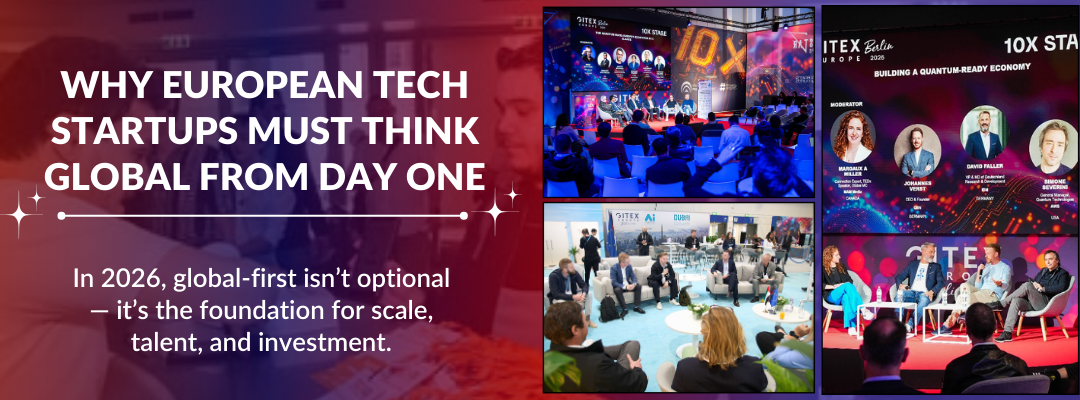
The mindset of European tech startups has changed dramatically. Gone are the days when founders would scale locally for many years before considering international markets. In 2026, successful startups adopt a global-first mindset from their earliest stages.
With Tech Summit × GITEX Europe 2026, happening on 30 June – 1 July, this shift becomes even more pronounced — as founders gain access to global ecosystems, investors, and cross-border partnerships that accelerate growth.
Here’s why startups in Europe must think internationally from day one — and how ecosystem platforms support this journey.
1. Local Markets Are Too Small — Innovation Needs Scale
No matter how strong a product is, most European countries don’t offer the market size needed for high-growth scaling. Startups need early exposure to:
- diverse customer bases
- multiple markets for validation
- global revenue streams
- international investors
GITEX Europe provides visibility far beyond a single region, connecting European founders with partners across Europe, Asia, the Middle East, and Africa.
2. Global Investors Are Actively Eyeing European Innovation
Despite fluctuating funding landscapes, global investors continue to see Europe as a hub for:
- deep tech
- AI infrastructure
- sustainability and climate tech
- cybersecurity
- enterprise software
- mobility and robotics
But investors want startups with international potential, not just local viability.
Tech Summit × GITEX Europe offers founders a chance to:
- pitch globally
- validate solutions across markets
- meet VCs who understand cross-border growth
- build investor-ready narratives
.png?_t=1767764848 "Why European Startups Must Adopt a Global-First Mindset in 2026 — Powered by Tech Summit × GITEX Europe")
3. Talent Is Borderless — and Startups Must Compete Worldwide
In 2026, talent is more distributed than ever. Top engineers in AI, cloud, and cybersecurity are sought after globally. Startups that limit their hiring strategy geographically fall behind.
Platforms like Hire Tech Talent and events like GITEX Europe help founders:
- access international talent pools
- build hybrid or distributed teams
- learn cross-cultural management
- understand global hiring trends
A global talent mindset = faster innovation, faster scaling.
4. Regulations Differ — Startups Need Multi-Market Readiness
Every region has its own regulatory frameworks. Europe (GDPR), GCC, APAC, and North America each follow different standards.
Startups with global ambitions must understand:
- data compliance
- cybersecurity requirements
- cross-border payments
- product localization
- privacy laws
Workshops and sessions at GITEX Europe help startups adapt products for multiple regions without slowing down growth.
5. Partnerships Are the Fastest Route to Global Scale
Going global alone is slow and expensive. Partnerships accelerate everything.
Key partnership types include:
- distributor partnerships
- enterprise pilots
- innovation hubs & accelerators
- corporate collaborations
- government-led opportunities
Tech Summit × GITEX Europe is designed to enable these connections through structured matchmaking and ecosystem networking.
6. The EU–GCC Innovation Corridor Is Expanding
Europe and GCC regions are strengthening collaboration in:
- sustainable tech
- smart mobility
- AI and robotics
- digital health
- fintech
GITEX Europe acts as a bridge between these markets, helping European startups enter fast-growing economies with strong digital strategies.
Conclusion
For European startups in 2026, thinking global from day one is not just a strategy — it’s a survival requirement. Competition is global, innovation cycles are faster, and markets are interconnected.
Tech Summit × GITEX Europe 2026 (30 June – 1 July) is where founders gain visibility, insights, and relationships needed to scale confidently across borders.