Industries Most Vulnerable to Disruption
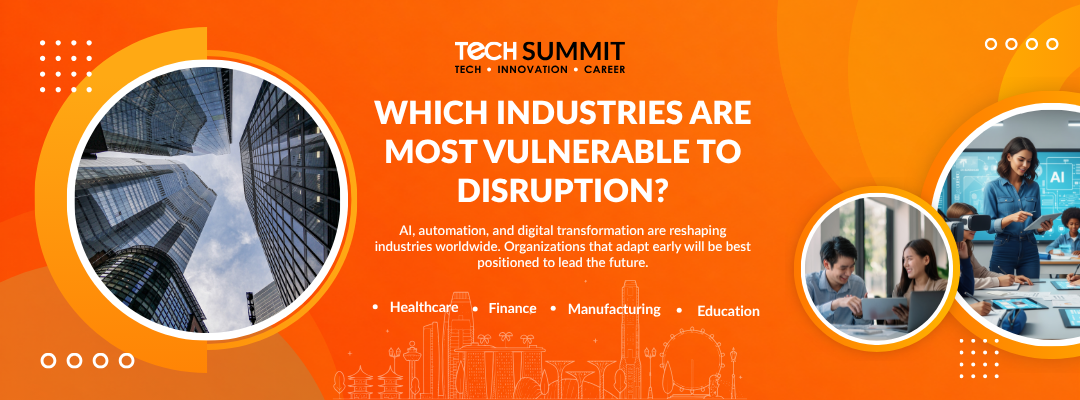
Industries most vulnerable to disruption are facing significant pressure from emerging technologies, changing customer expectations, and new business models. Disruption is often discussed as though it happens suddenly. In reality, most industries experience gradual change before reaching a tipping point. By the time disruption becomes obvious, the underlying transformation has often been underway for years.
Today, several sectors are experiencing major changes as artificial intelligence, automation, digital platforms, advanced analytics, and connected technologies reshape how businesses operate and how customers interact with them.
1. Healthcare
Healthcare is one of the industries most vulnerable to disruption as technology continues to change how care is delivered.
Advances in artificial intelligence, digital diagnostics, telemedicine, remote monitoring, and personalized medicine are creating new opportunities for healthcare providers and technology companies.
Patients increasingly expect healthcare services to be more accessible, convenient, data-driven, and responsive. Digital platforms can make consultations easier to access, while AI-powered systems can support healthcare professionals with diagnostics and decision-making.
The organizations that successfully combine technology with patient-focused services will be better positioned to adapt to changing expectations.
2. Financial Services
Financial services continue to evolve as digital platforms, embedded finance, fintech companies, and AI-powered solutions challenge traditional business models.
Consumers increasingly expect seamless digital experiences, instant transactions, personalized services, and easy access to financial products.
New entrants can compete with established institutions by using technology to reduce friction and provide highly convenient experiences. Traditional banks and financial institutions are therefore investing heavily in digital transformation.
The financial sector demonstrates how disruption can come not only from technology itself, but also from companies that use technology to deliver better customer experiences.
3. Manufacturing
Manufacturing is undergoing substantial transformation through automation, robotics, predictive maintenance, artificial intelligence, and connected production systems.
These technologies are improving efficiency while creating more flexible and intelligent industrial operations.
Smart factories can use real-time data to identify production problems, optimize processes, reduce downtime, and improve quality. Robotics can also automate repetitive tasks while allowing employees to focus on more complex responsibilities.
Companies that fail to modernize risk losing competitiveness as global manufacturers continue to adopt advanced technologies.
4. Education
Education represents another sector facing long-term disruption.
Online learning platforms, AI-powered tutoring systems, digital classrooms, and alternative credentialing models are expanding access to knowledge while challenging traditional approaches to education and workforce training.
Students increasingly expect flexible learning experiences that can adapt to their individual needs. At the same time, employers are placing greater importance on practical skills and continuous learning.
As a result, educational institutions are being encouraged to rethink how knowledge is delivered, measured, and connected to employment opportunities.
 5. Logistics and Supply Chains
Logistics and supply chains are increasingly shaped by automation, advanced analytics, artificial intelligence, and real-time visibility.
Businesses are looking for ways to improve efficiency, reduce costs, respond faster to disruptions, and build more resilient supply networks.
Technologies such as automated warehouses, intelligent routing systems, tracking platforms, and predictive analytics are helping companies make faster and more informed decisions.
As global supply chains become more complex, technology will increasingly become a key competitive differentiator.
6. Professional Services
Even professional services, traditionally viewed as relatively resistant to technological change, are beginning to experience disruption.
Legal services, consulting, accounting, marketing, and other knowledge-based industries are exploring how artificial intelligence can automate routine tasks and enhance decision-making.
AI can help professionals analyze large amounts of information, generate initial drafts, summarize documents, identify patterns, and support research.
Rather than eliminating professional expertise completely, these technologies are changing how professionals spend their time. Higher-value strategic thinking, creativity, judgment, and client relationships are likely to become increasingly important.
7. Why Customer Expectations Matter
The common thread across the industries most vulnerable to disruption is not simply the technology itself.
It is changing customer expectations.
Organizations are increasingly judged by their ability to deliver:
- Faster experiences
- More personalized services
- Greater convenience
- Better accessibility
- More efficient processes
- Smarter digital experiences
Customers are becoming more comfortable with digital-first services, which increases pressure on traditional organizations to adapt.
For additional context on how emerging technologies are reshaping industries and businesses, explore insights from the World Economic Forum.
8. The Importance of Adapting Early
Understanding the industries most vulnerable to disruption is only the first step.
Businesses also need to identify how disruption could affect their customers, employees, operations, and competitive position.
Organizations that wait until a new technology becomes mainstream may find it difficult to catch up. Companies that experiment early can develop new capabilities, understand customer behaviour, and identify opportunities before competitors.
Adaptation does not always mean completely replacing an existing business model. In many cases, it means improving existing services, adopting new tools, or creating new ways of delivering value.
Businesses can also learn from broader innovation trends and ecosystem developments through the Tech-Summit platform.
Looking Ahead
Disruption rarely eliminates entire industries. Instead, it reshapes how value is created and delivered.
Healthcare may become more personalized. Financial services may become increasingly digital. Manufacturing may become more automated. Education may become more flexible. Logistics may become more intelligent, while professional services may become increasingly augmented by AI.
The industries most vulnerable to disruption will continue to evolve as technology becomes more accessible and customer expectations continue to rise.
The businesses most likely to succeed are often those willing to adapt before change becomes unavoidable.
Conclusion
Which industries are most vulnerable to disruption? Healthcare, financial services, manufacturing, education, logistics, and professional services are all experiencing significant technological and market-driven transformation.
The real challenge is not predicting exactly which industry will be disrupted next.
It is understanding how customer expectations, emerging technologies, and new business models are changing the way value is created.
Disruption rarely happens overnight. The organizations that prepare early are more likely to turn disruption into an opportunity rather than a threat.
To explore more perspectives on technology, innovation, business transformation, and emerging opportunities, visit the Tech-Summit website.